
Poor Sembulan Tengah villagers stand to be millionaires overnight
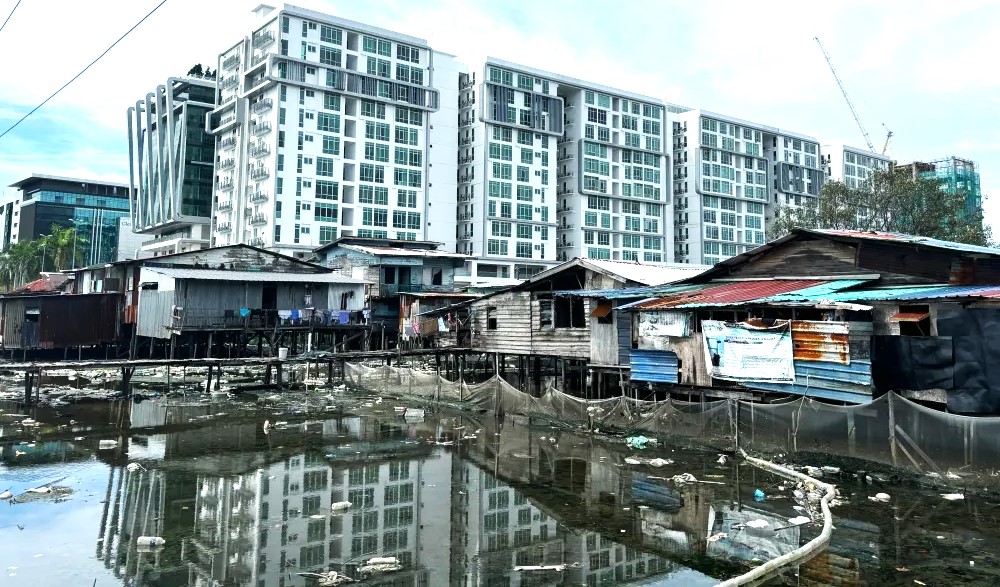
To say that Sembulan Tengah is an eyesore is an understatement. The 42-acre (17-hectare) water village whose history dates back to the early 20th century with the setting up of an ethnic Chinese fishing settlement has become not just an obnoxious rubbish dump but a shelter for illegal immigrants and criminals. Yet about 3,000 of the villagers, who are mostly locals, are defying eviction. Their 200 wooden stilt houses surrounded by high-rise buildings which include luxurious hotels, shopping malls, shops and offices, are standing on a pot of gold in the heart of Kota Kinabalu. Land here fetches a premium. And the villagers are looking forward anxiously to another meeting with the Kota Kinabalu mayor on October 8 to resolve the problem. The first one ended without a definitive solution on September 21 but with City Hall and the Lands and Surveys Department saying that the villagers would not be evicted for now.
What sparked the hue and cry was a notice served on the villagers by City Hall and the L&S Department telling them to vacate their village within 14-days. Failing which the authorities would demolish their houses. Those who defy the order will face a RM100,000 ($24,230) fine and five years jail. The move, according to the villagers, was targeted at squatters of an area of 3.5 acres which form 70% of a 5-acre piece of state land.

However the villagers, say Osman Omar Khan, their spokesman, will not abandon their village because they have nowhere else to go. Mr Osman, 57, who works for the Sabah Electricity Sendirian Berhad, says he has lived in Sembulan Tengah since he was born. He is their chairman of the Kampung Sembulan Tengah Residents and Welfare Association.
But Mr Osman tells Sabah Insights that they may consider a compensation of between RM100 and RM200 per square foot from the government in return for their land. This means that many of the poor villagers who mostly carve out a living as fishermen would become instant millionaires. Some of them own plots of land as large as 6,500 square feet which at RM200 per square foot would fetch RM1.3m. So far mayor Sabin Samitah has not said how much the compensation would be. But he conceded that landowners will be duly compensated while squatters would be given a “token” compensation. Mr Osman knows that prime land in the vicinity of his village fetches between RM1,000 and RM2,500 a square foot.
The 42-acre site is earmarked as the second phase of a 64-acre urban renewal scheme to transform the area into a township. The first phase of 22 acres of shops, hotels, restaurants and offices in complexes known as Harbour City and Sutera Avenue has long been completed. There are 169 landowners in Mr Osman’s village. But the land leases of 105 of them have expired, leaving 64 of them whose leases will expire in three or six years. Most of these leases run for 60 years. The government has stopped renewing them upon their expiry. Even then the government now seems to be in a hurry to acquire the land for the second phase of the urban renewal scheme. In fact government plans to develop Sembulan Tengah into a modern township started in the 1980s. But they never took off. No reasons were given. And the plans were revised many times by succeeding governments. The last revision was in May.
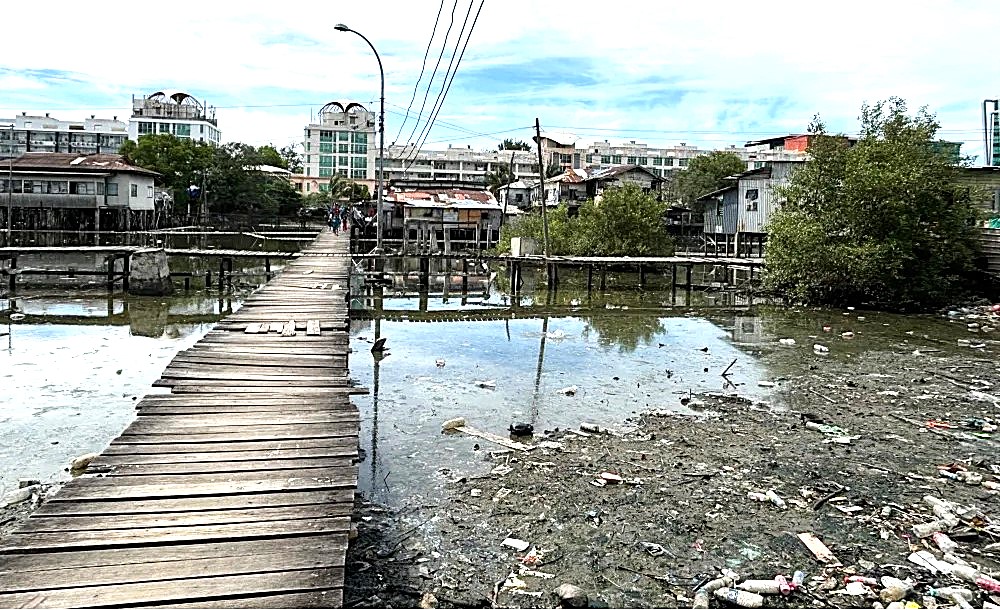
Since ethnic Chinese fishermen settled in Sembulan in the 1920s, the demographics of the village has changed as landownership passed from them to the Malays, Bajaus and Suluks who are largely fishermen like them. But what has turned Sembulan Tengah into a sleazy part of the city is the influx of illegal immigrants from the Southern Philippines in the 1980s. Since then it has become a den of thieves, robbers, burglars, pickpockets and drug addicts.
Twice Sabah failed to clean up Sembulan Tengah and turn the water village in the centre of a concrete city into a tourist attraction. Once in 2012 when then chief minister Musa Aman created the RM45m Sembulan River Park in Sadong Jaya modelled on the one of the Singapore River. He had wanted to clean up the water villages in Sembulan Lama and Tengah to present them to tourists as an exemplary village living in Borneo. More recently in 2022, Meraki Daat Sabah Initiative, a non-governmental organisation, also failed to get the villagers to clean up. It also had plans to turn Sembulan Tengah into a tourist haven where villagers could carve out a lucrative living with shops selling Sabah products and handicraft; and villagers serving tourists with coffee and meals in cafes and restaurants with walls painted with eye-catching murals. But many of the houses were too run down for the project. Rebuilding them would be too costly.

 Sabah Insights