
After almost 60 years of failure, Sabah tries again to achieve self-sufficiency in rice
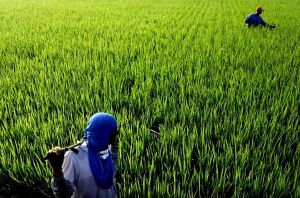
Rice is big business. But this realisation seems to have dawned on Sabah politicians rather belatedly. The east Malaysian state spends about a billion ringgit a year on imported rice to meet almost all its consumption as self-sufficiency in the food crop has dropped to a dangerous 22 per cent. Sabah imports most of its rice from Thailand, Vietnam, China, Pakistan and India. In almost 60 years, it has never met its 60 per cent self-sufficiency target first set in 1965 with the setting up of the Sabah Padi Board which was later mired in allegations of corruption and mismanagement. It was wound up in 1981 after chalking up massive losses and debts. Now the Sabah government is reviving it to do what it had failed to do.
Rice is not only a staple of the 3.5m Sabahans who are made up of the indigenous Kadazan-Dusun-Murut (KDM), Malays, Bajaus, ethnic Chinese and Indians. It is sacred to the Kadazan-Dusuns, the largest ethnic group who forms about a fifth of the state’s population. They are traditionally rice farmers and are the only people in the North Borneo island state who celebrate a rice harvest festival, the Kaamatan, at the end of May to honour the Bambarayon rice spirit and to thank Kinoingan, their god, for a bountiful harvest.

Thus it’s strange that Sabah has failed to grow enough rice for its own consumption. Penampang, the heartland of the Kadazan-Dusuns, was once the rice bowl of Sabah. But the district has lost almost all of its paddy fields to commercial buildings and housing estates. Now Kota Belud, 72km from Kota Kinabalu state capital, has become Sabah’s biggest rice growing district producing an annual 33,000 tonnes of paddy from about 10,000 hectares. Other rice growing districts are Tuaran, Papar, Kota Marudu, Tambunan and Keningau in the Sabah interior. Together they account for about 24,000 hectares of paddy fields producing about 70,000 tonnes of rice, about a fifth of Sabah’s annual consumption of 290,000 tonnes.
Achieving self sufficiency in rice shouldn’t be difficult for Sabah as the agriculture ministry has identified about 320,000 hectares of land that is suitable for paddy cultivation, with or without the paddy board. Jeffrey Kitingan, the state agriculture minister, says his ministry is increasing paddy acreage to 30,000 hectares with an aim to achieve 60 per cent self-sufficiency by 2030. This is if the fields are planted with high-yielding paddy seeds that will produce about six or seven tonnes of rice per hectare. Currently, rice fields produce about three tonnes of rice per hectare. With double cropping, Sabah would have surplus rice for exports.
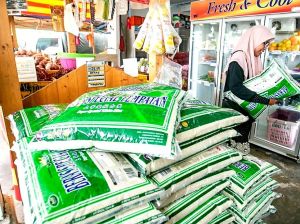
The immediate task is to ensure that rice fields are not turned over to buildings or the more lucrative oil palm plantations. Mr Kitingan reported that Sabah lost 500 hectares of rice fields last year. But he didn’t say what has become of them.
In the 1970s, Sabah was able to grow rice for about half of its needs partly due to the mechanization of rice cultivation introduced by the Sabah Padi Board. But as ploughing tractors and harvesters broke down, farmers abandoned them as spare parts and repairs were hard to get. Rather then going back to using buffaloes to plough fields and sickles to harvest paddy, farmers found it more lucrative to sell their fields to property developers. Land was much sought after as Sabah was in the early years of development.

The Sabah Padi Board, once revived, will take over the work of the agriculture ministry in managing rice cultivation. But clearly it was spurred by the desire to break the profitable rice import monopoly of Padiberas Nasional Berhad (Bernas), the national rice board, which is blamed for a rice shortage and spike in prices. Bernas’ monopoly ends in 2031. It has meanwhile refused to give it up.
Another grievance against Bernas is its failure to increase the income and productivity of Sabah’s rice farmers and help Sabah achieve rice self-sufficiency since it came to Sabah in 1979. Bernas’ other objectives are to ensure food security and fair and stable prices. In these, it has failed Sabah miserably.
Read also: The rice fiasco

 Sabah Insights